


Up
00%

Words
Share
X
,
LinkedIn
Cover
Everyone assumes the streak is about learning Spanish, but it’s always been about keeping the number going.
2,655
That's the number on my friend's Duolingo screen. Day streak, it says underneath. To the right is a flame icon. It's slightly faded, like a fire that's been burning so long it forgot anyone was watching, but is still expected to be there.
2,655 days is seven years and three months. Longer than the average person keeps a job. Longer than the entire run of Dragon Ball Z. Every one of those days, my friend opened this app. She wasn't building toward anything in particular, really. She just couldn't be the one to let it end.
Duolingo has a name for people who get here: Streak Society. (Mine is: Disgusting.) It's a tier. A membership in a club nobody applied to join; you just kept showing up until the app gave you a label.
Below the number, a calendar. May 2026. Days highlighted in orange: 1 through 13, a clean unbroken chain.
The 14th is gray.
The screenshot was sent to me on the 14th.
I think I might know what she did the next day.
What streaks track (hint: not your progress)
Duolingo's streak tracks one thing: consecutive days. Not whether you learned anything, got better, or spent four minutes instead of forty. Just: did you open the app? Did you complete the task? The answer is yes or no. The next day brings the same question, and the day after.
Across nearly every app doing this, it's the same unit: days. Learning apps, wellness apps, habit trackers. The headline number in Mobbin's dataset is almost always a day count. Not sessions completed, not vocabulary retained, not minutes spent. Days.

Counts are supposed to help form habits. Show up every day, the logic goes, and the behavior becomes automatic. The problem is that once the count has a name, a badge, and a home screen slot, it eclipses the thing it was counting. You're not working on a daily learning habit anymore. You're working on keeping a number going.
Why streak design feels personal
Of the 859 streak designs Mobbin analyzed, almost all of them do the same thing: they make the streak feel like it's about you. They're very good at talking about your goals, your progress, the version of yourself you're building toward. Lose the streak and the sting isn't about the count. It's about what you're capable of.
Hope
Duolingo's old call-to-action was: Continue. The new one is: Commit to my goal. "Continue" is just a decision in the moment, while "Commit to my goal" is a promise you make to yourself. Jackson Shuttleworth, who runs retention at Duolingo, called it "a massive win." What changed was what someone thought they were agreeing to when they tapped the button. That change drove 10,000 more people to open the app every day.
Atoms, a habit tracker, takes the same idea further. Under your progress, a single line: "Every action you take is a vote for the type of person you wish to become." Not "keep going." Not "great work." A vote. Atoms is, technically, an app for walking 15 minutes a day. It has chosen not to lead with that.
Pattern completion
Picture this: your Apple Watch rings are almost closed. You have 47 minutes left in the day and you need 12 more minutes of exercise to fill the third ring. It is 11:13pm. The last thing you want to do right now is take a walk around the block. You will probably take it.
Apple Fitness rings, GitHub contribution graphs, habit tracker calendars. When the streak is mostly unbroken, a missing day reads like an error you want to fix. This is the Zeigarnik effect: unfinished things stay active in the mind longer than finished ones. The open loop forces you to keep thinking about it.
Anthropomorphism
Duo isn't a mascot, because a mascot represents a brand. Duo is its own character. He has feelings about whether you showed up, and he will let you know. In Finch, a self-care app where you tend to a small bird, the bird grows as you complete your goals. It doesn't grow when you don't. Instead of tracking your wellness habits, you're raising something.
This is the Tamagotchi Effect: the attachment that forms when a digital thing needs you back. The original Tamagotchi, a Japanese toy from the 90s, died if you ignored it. People carried them everywhere: to school, to work. I remember myself as a ten-year-old, running to the school bathroom (you weren't allowed them in class) to scoop up Tamagotchi poop.
Fear
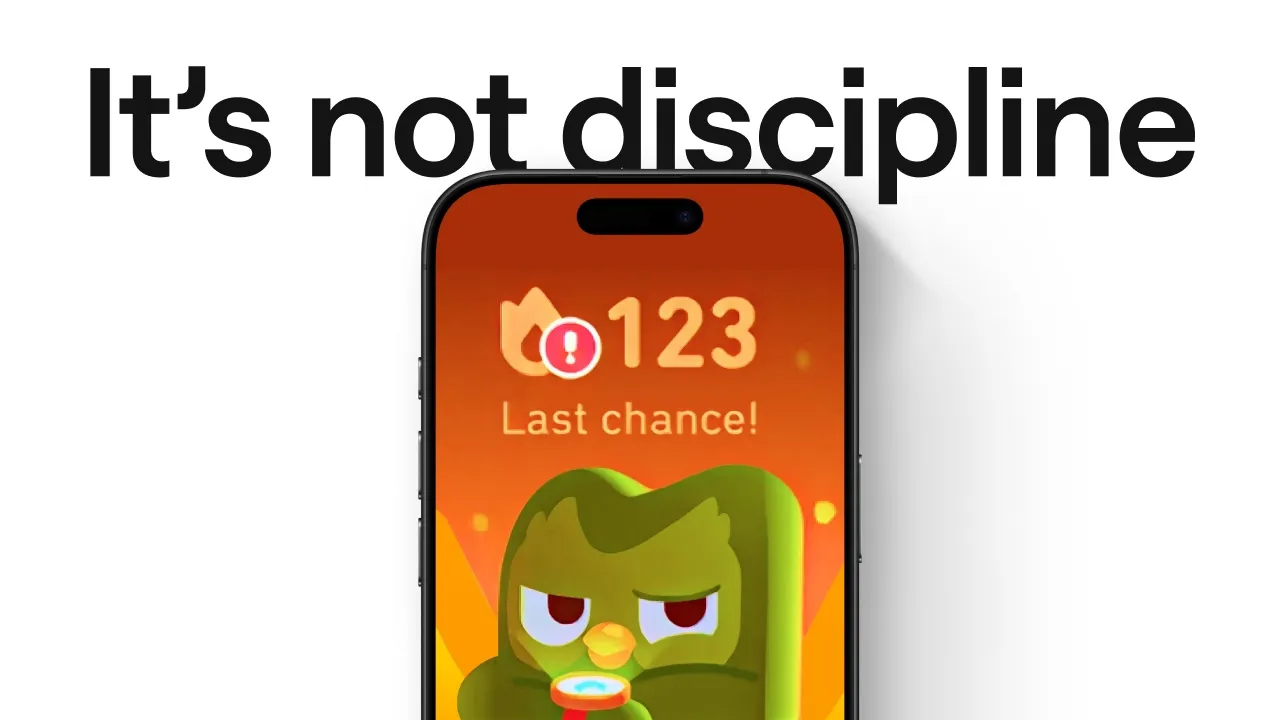
You get a push notification at 11:47pm. It's not from a person; it's from an owl. The first thing you notice is that it is not pleased with you. The second thing is that there's a countdown: 13 minutes before your streak resets. You had the whole day to do four minutes of Spanish. You spent it doing other things. Now you are awake, in the dark, feeling rather judged by an owl.
These streaks run on loss aversion: losing something hurts more than gaining the same thing feels good. Once-encouraging copy turns urgent. Timers appear. You stop chasing a number and start defending your record. The emotion isn't "I want to keep going." It's: "I cannot let this be the day I lose what I worked on for so long."
The dopamine loop behind streak notifications
In 1998, a neuroscientist named Wolfram Schultz found something strange about dopamine. The assumption was that dopamine releases after a reward: after the win, after getting the tangible thing. Schultz found it actually released before, in anticipation.

Adapted from Schultz, Dayan & Montague, Science 1997
The anticipation of a holiday is often better than the holiday itself. The trip has bad weather, a delayed flight, a hotel room with stains you don't want to know the origins of, a restaurant that got your fish starter wrong. The anticipation has none of that.
A Duolingo notification works the same way: before you've opened the app.
James Clear, Charles Duhigg, and Nir Eyal all map it the same way: cue, craving, response, reward. The notification fires. The craving isn't for Spanish. It's for the streak not ending. Your brain has already started feeling the relief of it surviving before you've picked up the phone. Not opening now means losing something your brain had already started treating as yours.
You don't have to enjoy learning Spanish. You just have to dislike losing the streak more than you dislike opening the app.
When the streak matters more than the habit
When a number becomes the goal, people optimize for the number.
Duolingo tested this directly. One group had to complete their full daily goal to keep a streak. Another group only needed to finish a single lesson, any lesson, a few minutes. Over 40% more people kept a 7-day streak when the bar was lower.
Keeping the streak alive mattered more to everyone than the actual learning.
(I once downloaded Genshin Impact on hotel wifi because I was about to miss a login streak. Genshin is a large game that patches frequently. The patch took several hours. I didn't play. I logged in, collected the daily reward, and closed it. I have no memory of what the reward was.)
The streak will break. When it does, the fear doesn't just make you sad about a number. You start treating it as proof of something about you. Psychologists Janet Polivy and C. Peter Herman called this the "what the hell" effect: missing once doesn't just produce guilt, it produces abandonment. You're not a person who just missed a day. You're a person who was never able to do this.
In 1973, Mark Lepper, David Greene, and Richard Nisbett ran a study on children who liked to draw. Some were rewarded for it; others weren't. When the reward was removed, the rewarded kids drew less: less than kids who were never rewarded, less than they themselves had drawn before. The external reward had replaced the reason they liked drawing. When it was gone, they just drew less.
Missing a day doesn't break a habit, research shows
Phillippa Lally spent 12 weeks at University College London tracking people trying to build new habits. These were simple habits: eating fruit with lunch, going for a run before work. Small, repeatable behaviors that eventually became automatic.
"Missing one opportunity to perform the behaviour," Lally found, "did not materially affect the habit formation process."
Missing a day had almost no effect. People who missed one day and came back the next were on the same trajectory as people who never slipped at all.
What's different, though, is how missing a day feels. The "what the hell" effect is real. People do spiral, and a broken streak does feel like a verdict on your capability, your commitment, your grit. But that's psychology, and Lally was measuring behavior. Whether you feel like you failed, and whether you actually broke the habit, aren't the same thing.
Most streak systems are built on the opposite assumption: that missing a day is catastrophic. The timers, the threatened owls, the 11pm notification. All of it is built on that assumption.
From Done, an app literally built for streaks:


Streak design doesn't need the fear to be accurate. It just needs it to be tangible.
Why streak freezes exist
A streak freeze is a small feature that lets you miss a day without losing your streak. It exists because missing a day was designed to feel catastrophic. They built the problem. Then they built the solution.
When Duolingo let users hold two streak freezes at once instead of one, 200,000 more people came back every day. That scale adds up: nearly 8 million Duolingo learners now have a streak of 365 days or longer, a year or more without missing a day. The social layer pushes it further: learners with at least one shared friend streak are 22% more likely to complete their daily lesson.

Duolingo has been figuring this out over the years. Streak freezes, repairs, "Commit to my goal," friend streaks. They all have the same goal: to let you keep your number. If you showed up for months, then had a rough week and came back after, you're still the kind of person who shows up.
Duolingo isn't alone. Alma lets you pause your streak for up to 14 days. Vacation mode, named as such. Paired gives every user a monthly freeze, automatically replenished. Runna doesn't freeze anything: miss a workout and it reschedules into your current week. The plan just adjusts.
Finch takes it furthest. When you miss a day, it doesn't blank it or X it out. It shows a hammer icon you can use to repair it. A missed day doesn't look like a blank. It looks like something you can still fix.

2,656
My friend from the opening, the one with 2,655 days? I asked her what could possibly have motivated her to reach a 2,655-day streak.
Her answer: "I have an addictive personality."
2,655 days is long enough that the habit research stops being relevant. Somewhere around year four or five, the streak probably stopped being a streak and became part of her morning routine, filed somewhere between getting a coffee and sending me reels of cute cats.
She is, objectively, a member of Streak Society. (Her opinion on this has not been solicited.)
She opened Duolingo the day after sending me the screenshot. The number went to 2,656. She's started going to Korean classes.
2,656.
